Marketing Agency Valuation: The Straight-Talk Guide to What Your Firm is Truly Worth

If you disappeared from your business tomorrow, would the enterprise value evaporate with you? Most founders inadvertently build a high-paying job rather than a transferable asset. This is why a marketing agency valuation often feels like a shot in the dark. You've likely spent years scaling revenue only to realize that top-line growth doesn't always translate to a higher exit price.
It's frustrating to navigate conflicting advice about SDE versus EBITDA or to fear being undervalued during due diligence. You've built something significant, and you shouldn't have to guess at its market price. This guide strips away the broker fluff to show you the structural drivers and financial metrics that actually dictate your firm's worth. We prioritize grounded realism over flashy sales talk to ensure you don't leave money on the table.
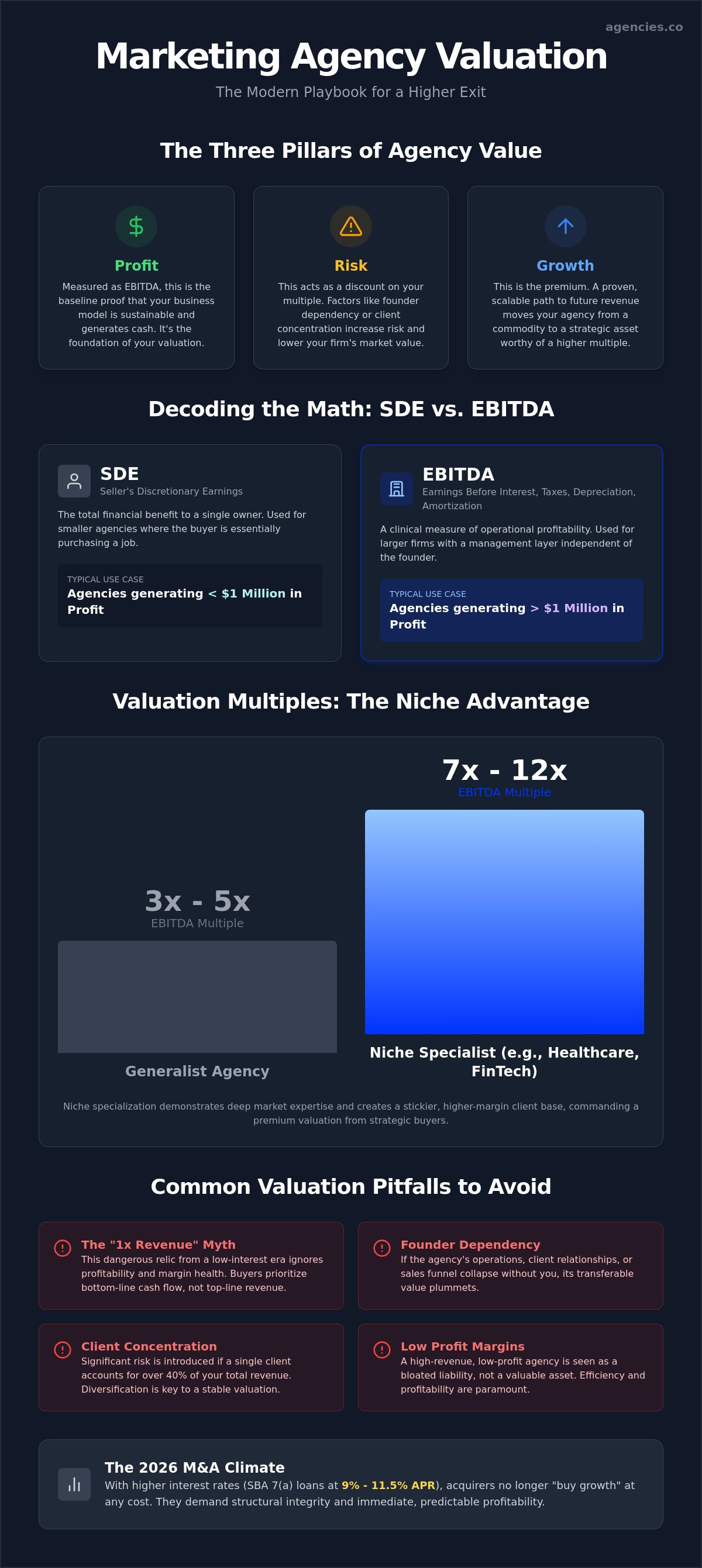
We'll explore why niche specialists in sectors like healthcare or fintech are currently commanding 7x to 12x EBITDA while generalists struggle at the lower end of the spectrum. You will walk away with a clear understanding of your current valuation range and a roadmap to move the needle on your multiple before you ever hit the market. It's time to gain the confidence needed to discuss terms with sophisticated acquirers on your own level.
Key Takeaways
Learn the critical distinction between SDE and EBITDA to ensure you're measuring the correct profit metric for your agency's specific size and scale.
Discover why a true marketing agency valuation ignores the dangerous "revenue multiple" trap in favor of predictable, contract-backed cash flows.
Identify the structural levers, such as niche specialization and revenue stickiness, that allow you to move the needle on your final exit multiple.
Understand how to protect your firm's market value by maintaining strict confidentiality and securing key talent before you ever enter due diligence.
Transition from "for sale" to "acquisition ready" by positioning your agency as a strategic solution to a vetted buyer’s specific problem.
Table of Contents
Protecting Your Multiple: Avoiding Common Valuation Pitfalls
Strategic Positioning: Moving from "For Sale" to "Acquisition Ready"
The Reality of Marketing Agency Valuation in 2026
A marketing agency valuation is not a reflection of your past effort or the prestige of your client roster. It is a cold, calculated assessment of the present value of future predictable cash flows. Buyers aren't purchasing your history; they are purchasing your agency’s ability to generate cash after the keys change hands. In the 2026 market, this distinction is sharper than ever. Higher interest rates, with SBA 7(a) loans currently hovering between 9% and 11.5% APR, have shifted the focus away from pure scale. Acquirers are no longer interested in "buying growth" at any cost. They want structural integrity and immediate profitability. While standard business valuation methodologies provide the foundational framework, the final number is always a snapshot in time. It's influenced by your internal performance and the external M&A appetite for your specific niche.
Why "Rules of Thumb" Fail Agency Owners
The "1x revenue" rule is a dangerous relic of a lower-interest era. It's an arbitrary benchmark that ignores margin health and overhead efficiency. If your agency does $5 million in revenue with a 10% margin, you're a high-risk asset compared to a $3 million agency with a 30% margin. Strategic buyers prioritize the bottom line. They look for how much cash is left after every expense is paid. Relying on outdated 2021 or 2022 multiples in 2026 is a recipe for disappointment during due diligence. The market has moved. Today, a lean, profitable firm with $2 million in revenue is often worth more than a bloated $6 million generalist shop. High revenue with low profit isn't a business; it's a liability.
The Three Pillars of Value: Profit, Risk, and Growth
Your agency's market value rests on three foundational pillars. These determine whether you command a premium multiple or a baseline offer. When these pillars are aligned, you create a compelling narrative for acquirers.
Profit: This is your baseline, typically measured as EBITDA. It proves the business model works and can sustain itself without constant capital injections.
Risk: This acts as a discount. If 40% of your revenue comes from one client, or if the agency collapses when you take a vacation, buyers will slash your multiple to account for that instability. Structural risk is the primary reason deals die in the final hour.
Growth: This is the premium. Buyers pay more for proven, scalable acquisition channels. If you can show a predictable path to doubling revenue over the next three years, you've moved from a commodity to a strategic asset.
Understanding these pillars allows you to stop guessing at your worth. It's about moving away from ego-driven metrics and focusing on what a sophisticated buyer actually values: a predictable, low-risk cash machine. If you haven't decoupled your personal brand from the agency's operations, your marketing agency valuation will suffer regardless of your top-line revenue.
Decoding the Math: EBITDA, Multiples, and SDE
Calculating a marketing agency valuation requires looking past the bank balance to understand the underlying earnings power of the enterprise. You'll encounter two primary metrics: SDE and EBITDA. Seller’s Discretionary Earnings (SDE) represents the total financial benefit to a single owner, including salary, perks, and profit. In contrast, EBITDA is a more clinical measure of operational profitability. As a general rule, agencies generating under $1 million in profit are valued on SDE because the buyer assumes they are purchasing a role they must eventually replace. Larger firms move to EBITDA because they typically possess a management layer that functions independently of the founder. Understanding how to calculate business valuation starts with this distinction. If you use the wrong metric, you'll either overprice yourself out of a deal or leave significant capital on the table.
The multiple is essentially a proxy for risk. It represents how many years of current profit a buyer is willing to pay upfront based on the stability of your future cash flows. To arrive at a defensible number, you must engage in "normalization." This is the process of adjusting your financial statements to show what the business would look like under new ownership. It strips away your personal tax strategies to reveal the raw engine of the agency. If you aren't sure where your firm currently sits on this spectrum, a professional agency valuation can provide the clarity needed before you engage with potential acquirers.
EBITDA Add-Backs: Finding Your Hidden Value
Add-backs are non-recurring or personal expenses that are added back to your net income to reflect the true operational profit of the business.
Founder salary adjustments (the difference between your actual draw and a market-rate replacement)
One-time legal fees, rebranding costs, or specialized M&A consulting
Non-business travel, personal vehicle leases, and discretionary club memberships
Be cautious with your calculations. Aggressive add-backs trigger immediate red flags during due diligence. If you attempt to add back every meal or personal expense since 2024, a sophisticated buyer will question the integrity of your entire financial package.
The Multiple Hierarchy: What Drives a 4x vs. an 8x?
The market applies a hierarchy based on the sustainability of your cash flow and your agency's level of specialization. In the 2026 market, the gap between generalists and specialists has widened significantly.
4x-5x: These firms suffer from high owner-dependency, rely on project-based revenue, and often have high client concentration issues.
6x-7x: These agencies have a strong management team, consistent recurring retainers (typically 60% or more of revenue), and a clear niche.
8x+: This elite tier is reserved for firms with proprietary tech, AI-integrated processes, high margins, and a perfect "strategic" fit for the buyer.
Lower risk always equals a higher multiple. If your agency relies on a single client for half its revenue, the buyer sees a cliff rather than a company. Conversely, an agency that can prove it doubles its profits while maintaining a lean staff through automation will always command a premium.
The Invisible Value Levers: What Buyers Actually Pay For
Valuation isn't just about the numbers on your P&L. If two agencies both report $1 million in EBITDA, one might sell for $4 million while the other fetches $8 million. The difference lies in the "invisible" levers that mitigate risk and ensure future performance. Buyers are looking for structural durability. They want to know if your revenue is "sticky" or if it will evaporate the moment you stop answering your phone. A sophisticated marketing agency valuation considers these qualitative factors as heavily as the quantitative ones. Acquirers don't just buy your past; they buy the security of your future.
Revenue stickiness is the first lever. Don't confuse a long-term relationship with a contractual obligation. A "handshake" retainer is a liability in a sale. Buyers want to see enforceable contracts that guarantee cash flow over time. According to 2026 industry data, retainer-based agencies see an average annual churn of 18%, while project-based firms face a staggering 42% churn rate. This predictability is exactly what your digital agency is really worth to a strategic acquirer. If you haven't locked in your clients with clear terms, you haven't locked in your firm's value.
Niche authority and client concentration are the next critical factors. Specialized agencies in high-barrier industries like healthcare or fintech command higher premiums because their expertise is harder to replicate. Conversely, client concentration is the silent killer of deals. If a single client accounts for more than 20% of your revenue, your multiple will likely be capped. Buyers view this as a single point of failure. If that client leaves, your business is crippled. Diversification is your best defense against a low-ball offer.
Revenue Quality and Predictability
True recurring revenue is the gold standard of M&A. Project-based income is often treated as "bonus" revenue rather than core enterprise value. To prove your agency’s predictability, you should provide a 24-month historical audit showing consistent Lifetime Value (LTV) and manageable churn. This data proves that your growth isn't a fluke; it's a repeatable system. Buyers pay for systems, not luck.
The "Founder Trap" and Operational Independence
Operational independence is the ultimate value driver. If you can't take a 30-day vacation without the agency stalling, you don't own a business; you own a high-stress job. Acquirers pay a premium for documented Standard Operating Procedures (SOPs) and a capable management layer. They want a "second-in-command" who handles the daily operations. Your marketing agency valuation peaks when you become the least important person in the room. If the agency’s success is tied to your personal charisma, the risk is too high for a top-tier multiple.
Protecting Your Multiple: Avoiding Common Valuation Pitfalls
Confidentiality isn't a luxury; it's a prerequisite for a high-multiple exit. If your intention to sell leaks to your team or your client roster prematurely, you've effectively sabotaged your marketing agency valuation. Clients fear a drop in service quality and start vetting competitors. Top-tier talent begins looking for more stable ground. This sudden instability creates a "risk premium" that buyers will use to slash their offers. You need a disciplined process that keeps the transaction under wraps until the ink is dry. Protecting the narrative is just as important as protecting the profit margins.
Financial hygiene is the next deal-breaker. Messy books signal a messy business. If an acquirer has to untangle personal travel expenses from your operational costs, they'll lose confidence in your reporting. This friction slows down due diligence and gives buyers more time to find reasons to walk away. Clean, transparent financials are a sign of structural integrity. Similarly, avoid the "burnout exit." Selling when you're exhausted leads to poor decision-making and a lack of leverage. You want to sell when the business is thriving and you still have the energy to command the room. Desperation is a scent that sophisticated buyers can detect from miles away.
Managing Client Concentration Risk
The "20% Rule" is the standard benchmark in agency M&A. If any single client accounts for more than 20% of your revenue, you're at risk. Buyers see this as a single point of failure that could cripple the agency overnight. If you have a concentration issue, focus on diluting it before you list. This might mean pausing growth on your largest account while aggressively scaling smaller ones to balance the books. If the concentration is baked into your business model, you must prove that the relationship is institutional rather than personal. Multi-year contracts and a dedicated account team can help mitigate the perceived risk during a transition.
The Dangers of General Business Brokers
Generalist brokers often struggle to value the intangible assets that make a marketing firm valuable. They treat an agency like a laundromat, focusing only on the physical assets and the lease. They don't understand the premium associated with niche authority or the scalability of a proprietary process. Working with a specialized agency M&A advisor ensures your firm is positioned correctly for the right audience. You need a partner who knows the difference between a project-based shop and a strategic consultancy. They understand how to defend your multiple by highlighting the structural drivers that generalists simply miss.
Before you engage with potential buyers, ensure your firm is protected from these common traps. A professional agency valuation is the first step in identifying and fixing these leaks before they drain your exit value.
Strategic Positioning: Moving from "For Sale" to "Acquisition Ready"
Positioning is the act of framing your agency as a solution to a buyer’s specific problem. It isn't just about presenting a spreadsheet of your EBITDA; it's about explaining why that profit is safer and more scalable in the buyer's hands than it is in yours. A true marketing agency valuation serves as the starting line. Positioning is what carries you through the finish. If you simply list your business "for sale," you are a commodity. If you present yourself as the missing piece of a larger strategic puzzle, you become an essential asset. You must shift the narrative from what the business has done to what it will do under new ownership.
The Agencies.co approach combines precise valuation with strategic positioning and vetted buyer outreach. We don't believe in the "spray and pray" method used by generalist brokers who prioritize volume over alignment. Instead, we utilize a confidential marketplace to create a competitive environment without public exposure. This protects your firm’s reputation while ensuring you only engage with acquirers who have been thoroughly vetted for both capital and cultural fit. Who you sell to matters as much as the final number. A poor match can destroy the legacy you’ve spent years building in a matter of months.
Preparing for the Due Diligence Inspection
Before you ever hit the market, you must build a comprehensive "Data Room." This digital repository should house your normalized financials, enforceable client contracts, and documented Standard Operating Procedures. Professional due diligence management is essential to prevent "deal fatigue," which occurs when the sheer volume of buyer requests causes a founder to lose focus or interest. You must understand that due diligence is where the "Price" agreed upon in the Letter of Intent (LOI) becomes the actual "Proceeds" that hit your bank account. If your data room is disorganized, expect the buyer to chip away at your valuation until the deal is no longer recognizable.
Finding the Right Match in a Vetted Network
There is a fundamental difference between "Financial Buyers" like Private Equity (PE) firms and "Strategic Buyers" like larger agencies or tech companies. PE firms typically look for high margins and low owner-dependency to roll your firm into a larger portfolio. Strategic buyers often pay a premium for your specific niche expertise or a proprietary process they currently lack. Using a vetted marketplace allows you to find these strategic matches, many of whom are buyers you likely didn't even know existed. This competitive tension is what ultimately drives your multiple higher.
If you're ready to stop guessing and start preparing for a high-value exit, get a professional agency valuation and positioning audit. This isn't a passive service. It's the active work of moving from a business owner to a successful ex-founder with your legacy and bank account intact.
Moving From Founder to Ex-Founder
Your agency is more than a collection of case studies and client logos. It's a financial asset that requires deliberate structural engineering to reach its full market potential. We've established that a defensible marketing agency valuation depends on decoupling your personal brand from daily operations and proving the stickiness of your revenue. If you don't address these invisible value levers now, you'll find yourself at the mercy of buyers who specialize in finding reasons to discount your life's work.
Success in M&A isn't about finding any buyer; it's about finding the right buyer through a disciplined, confidential process. You need an ally who understands the nuances of the marketing sector and can navigate the complexities of due diligence without compromising your firm's reputation. As specialized agency M&A experts, Agencies.co provides end-to-end transaction management and access to a confidential, vetted buyer marketplace to ensure your exit is as seamless as your growth was.
You've already done the hard work of building a business that matters. Now, it's time to ensure you receive every dollar of value you've created. Get a Professional Valuation & Positioning Audit from Agencies.co today and take the first step toward a secure, high-multiple exit. You've earned the right to a clean handoff.
Frequently Asked Questions
What is the average valuation multiple for a marketing agency in 2026?
Current 2026 data shows that valuation multiples range from 2x to 12x EBITDA depending on your business model. Project-based generalist agencies typically sit at the lower end, between 2x and 4x. In contrast, specialty agencies in high-demand sectors like healthcare or fintech often command 7x to 12x. Firms with over 60% recurring retainer revenue generally see multiples in the 6x to 9x range.
How do I calculate EBITDA for my agency sale?
Start with your net income and add back interest, taxes, depreciation, and amortization. To arrive at a realistic marketing agency valuation, you must also "normalize" these earnings by adding back non-recurring expenses or personal draws. This process reveals the raw operational profit a buyer can expect to generate once your personal tax strategies are removed from the books.
Does my agency need to have recurring revenue to be sellable?
Recurring revenue isn't a requirement for a sale, but it is a requirement for a premium price. Project-based agencies are sellable but face an average annual churn rate of 42%, which buyers view as a significant risk. Retainer-based models offer the predictable cash flow that justifies higher multiples and attracts more sophisticated strategic acquirers.
What are common "add-backs" in an agency valuation?
Common add-backs include founder salary adjustments to market rates, one-time rebranding costs, and personal expenses like vehicle leases or non-business travel. These adjustments are made to show the business's "real" earnings power. You must ensure every add-back is documented and defensible, as aggressive adjustments are often the first things challenged during due diligence.
How does client concentration affect my agency’s value?
Client concentration is a major risk factor that can cap your multiple regardless of your growth. If any single client represents more than 20% of your revenue, buyers see a single point of failure that could cripple the agency. Diversifying your client base before you hit the market is one of the most effective ways to protect your final exit price.
Should I use a business broker to sell my marketing agency?
General business brokers often struggle to value the intangible assets, such as niche authority or proprietary processes, that make a marketing firm valuable. They may treat your agency like a commodity retail business. A specialized M&A advisor understands the structural drivers of the sector and can position your firm to a vetted network of high-quality buyers.
How long does the agency valuation and sale process typically take?
The entire process usually takes between 6 and 12 months from the initial marketing agency valuation to the final closing. This window allows for financial normalization, strategic positioning, buyer outreach, and the standard 60 to 90 day due diligence period. Attempting to rush this timeline often leads to deal fatigue or a lower final valuation.
Can I sell my agency if I am still the primary person doing the work?
You can sell an owner-dependent agency, but you'll likely receive a lower multiple and be required to stay for a longer earnout period. Buyers want to purchase a transferable system rather than a high-paying job for themselves. To maximize your value, you should focus on building a management layer and documenting SOPs at least a year before you list.